Next level voting
Decisions the whole room can get behind.
With ConsensIQ everyone spreads points across several options. Round by round the weakest one drops out, until you are left with the choice most people actually support.
- No app needed
- In person, hybrid or online
- Up to 500+ participants
What the room sees
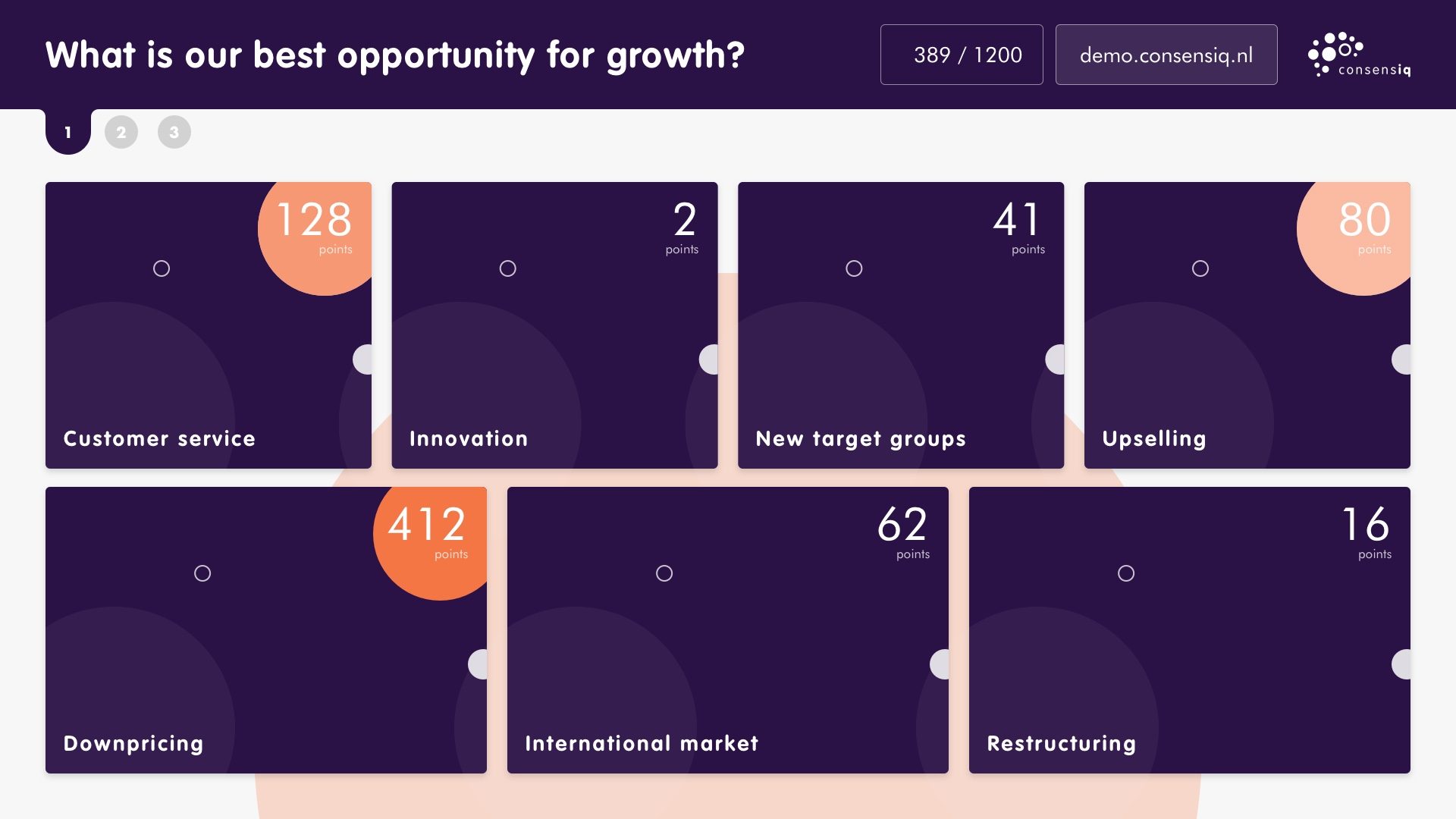
The presentation screen shows points moving in real time. Options with more support grow bigger. After each round, one drops out.
What is our best opportunity for growth?
- 1200Customer service
- 2300Innovation
- 1900New audiences
- 1400Upselling
- 700Lower prices
- 1600International markets
- 900Restructuring
Participant
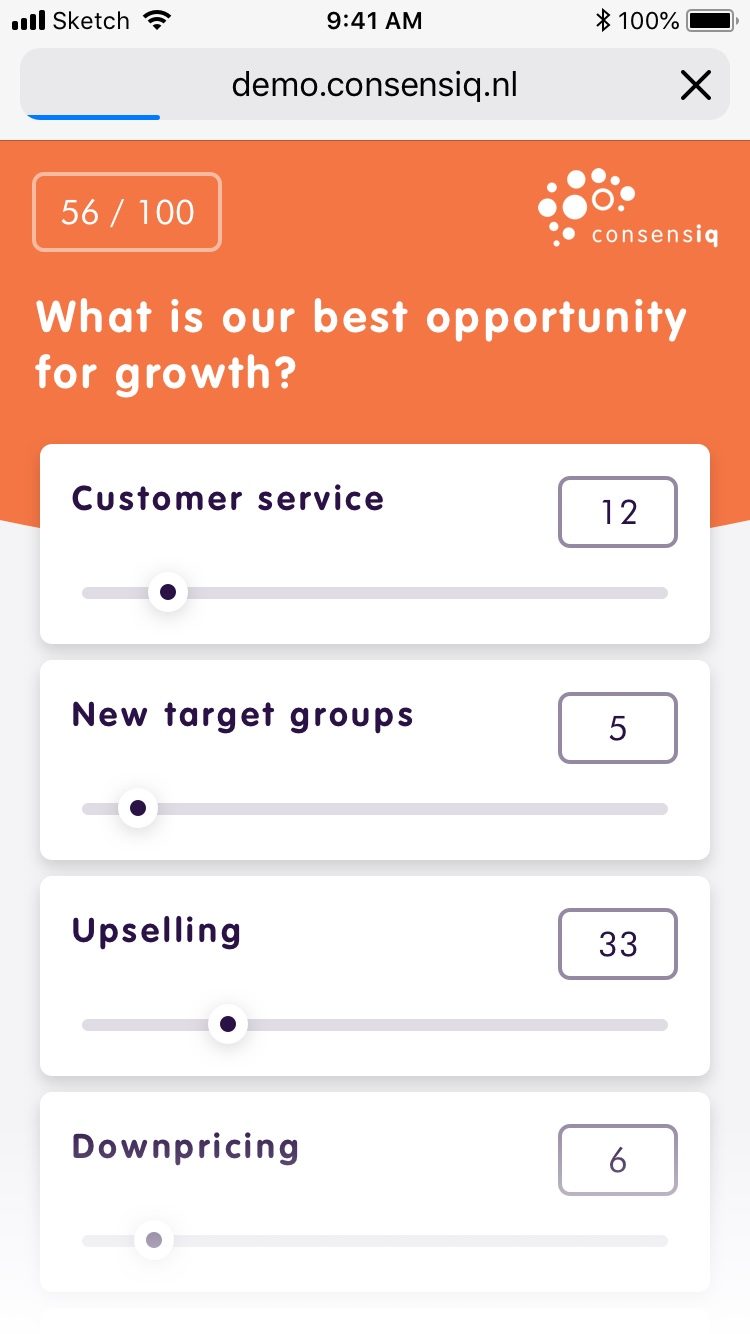
What is our best opportunity for growth?
Moderator
- Customer service
- Innovation
- New audiences
- Upselling
Three steps to a decision people back
- 1
Spread your points
Everyone opens the question on their own phone through a link or QR code and spreads, say, 100 points across the options. Not sure? Spread them out. Certain? Put them all on one.
- 2
Talk it through
While the question is open you can move your points. If someone makes a great case, you can change your mind on the spot. The facilitator can freeze voting to make room for discussion.
- 3
The weakest drops out
After each round the option with the least support is removed. Anyone who backed it gets their points back to use again. Nobody gets voted off, so everyone stays involved until the end.
A majority isn't the same as support
With a regular vote the biggest group wins and everyone else loses. ConsensIQ looks for the option most people can stand behind.
Regular voting
- One vote, cast once, yes or no
- 51% wins, 49% feels ignored
- People on the losing side tune out
- Nuance and doubt get lost
ConsensIQ
- Spread points across up to 10 options
- The option with the broadest support wins
- Nobody is voted off, your points move with you
- You see how strong each preference really is
How teams and organisations use it
Prioritising and strategy days
Public consultation for local government
Member meetings and trade associations
Conferences and events
Healthcare and non-profits
Training and workshops
Education and research programmes
- Use cases
See how it works in two minutes
The explainer shows what participants, the facilitator and the room each see.
Born in the meeting room, built by a tech team
The facilitators at Dagvoorzitter.nl kept seeing the same thing: a room full of smart people, a vote, and then half the room feeling unheard. Together with livewall, the Tilburg team behind PresentersWall, they built a tool that shows what a group wants together. The facilitators brought years of experience on stage, livewall brought the technology.
Read the full storyConsensIQ at a glance
- What
- A web-based consensus tool: participants spread points across options, and the weakest option drops out each round.
- For whom
- Organisations, municipalities, associations and event organisers who want a group to choose together.
- How
- Spread points (e.g. 100), several voting rounds, points on dropped options go back to the participant.
- Options
- Up to 10 per question, as text or image.
- Participants
- Hundreds at once, day licences up to 500+.
- Format
- In person, hybrid and online.
- App needed?
- No. Join via a link or QR code on your own phone.
- Data
- Stored in the EU, participants can join anonymously.
- Maker
- livewall (makers of PresentersWall, Tilburg), developed together with Dagvoorzitter.nl.
Key terms
- Consensus voting
- Consensus voting is a way of voting that looks for the option with the broadest support across a group, rather than the option with the most first choices. People show how strongly they back each option, and options without wide support drop out step by step.
- Measuring support
- Measuring support means making visible how many people stand behind a choice, and how strongly. With point voting you see not only what wins, but also whether the rest of the group can live with it.
- Point voting (cumulative voting)
- In cumulative voting every participant gets a fixed number of points, for example 100, and spreads them across several options however they like. Someone with a strong preference puts most points on one option, someone who is unsure spreads them out.
Frequently asked questions
What is ConsensIQ?
ConsensIQ is a digital consensus tool that lets a group choose, live and over several rounds, which option has the broadest support. Participants spread points across up to 10 options on their own phones, and after each round the option with the least support drops out.
How is it different from regular voting?
In a regular vote the biggest group wins, while in ConsensIQ the option most people can support wins. You spread points instead of casting one vote, and if your option drops out you get your points back to use again.
What is consensus decision-making?
Consensus decision-making is a way of deciding where a group looks for an outcome as many people as possible can support, rather than one that just scrapes a majority. ConsensIQ makes this workable for large groups by using point voting and removing weak options step by step.
How many people can take part?
ConsensIQ works for groups from a handful of people up to several hundred, with day licences for 500+ participants. For larger events we are happy to put together a custom proposal.
Together we know better
Tell us what you need to decide and how many people are involved. We'll show you in a short demo what that looks like in ConsensIQ.